Those who were willing to take the risks started the railroad expansion across the continent. Rail barons putting forth their money to push the iron horse forward, betting their investment would make a return. They didn’t know if they would come through it rich, or as a pauper. But, they kept pushing until the lines connected and the routes were made.
Last Spike reaches back to the time when the rails were being laid down North America. You are placing the rails, building the routes between the cities, and investing more money in those cities. With a little luck, planning, and daring you could be the one coming out on top when the last rail is nailed down to the tie with the last spike driven.
Each player starts with a number of tiles. They decide which one to place, and when. A tile only fits in one place, so timing the placement of a section of rail is important. Track also costs money, and you have a limited amount supply. But, remember, it is also important to invest in the cities you are building the railroad to.
There are towns along the way as you stretch between St. Louis and Sacramento. You have the opportunity of buying up land in each. The more land you own when a section completes linking your land to another city earns you money—money needed to place more track and buy more land.
This leads to different strategies on how you place track and buy land, creating sets which increase the value, but also cost more to buy. So, you have to balance your expenses between how you extend your track and what property you own.
Play continues until the last spike is driven completing passage between the two endpoints. A bonus is received for completing the final route, which introduces an endgame strategy. Do you go for ending the game to block other players from the bonus, does the bonus give you enough money to move you into the lead, or do you hold onto the tile so you can work on completing other sections to build your bank account?
I played Last Spikeat SaltCon. It was quick to learn. Three new players sat down with an instructor and there was only one question that came up because I was pushing the bartering rule (I was way behind). Set up and clean up were also quick. The components, although simple, were quality made and will last for some time.
Last Spike was designed by Tom Dalgiesh and published by Columbia Games. It is designed for 2–6 players of ages 10+ (I believe you can go a little younger, especially for kids who have played other board games). The game is designed to take 30 minutes, and our game with three new players took about that long.
So the only question is, do you have the steel to take it to the end of the line?
The Royal Veterinary College is looking for older dogs to take part in a survey that is exploring the impact of health and training on behaviour.
They've had a fantastic response (almost 5000 so far!) but they are short of dogs eight years or older. So if you have an oldie - purebred or cross and wherever in the world you are - they would be very grateful if you could find a few minutes to complete the survey.
I've already submitted info on my amazing oldster, Jake. This video comprises footage of him shot in the past few weeks. He is 14 years old - a GSD/Dobermann x with a sprinkling of English Setter.
Here is a character for a modern day set of adventures where monsters and magic exist (a low scale Cthulhu crossed with information drawn from Monster Hunters International (MHI), Dresden Files, and X-Files). The game is starting out with the players being recruited to work for a government agency.
The characters know they are being asked to investigative cases that other parts of the agency are not working on due to the cases sensitive nature. They are being recruited for the different skills that are not traditional law enforcement, but include skills to create an investigation unit to solve crimes that may not always involve the need of traditional force.
The players have the additional information the supernatural exists. The cases being investigated are sensitive because the investigators need to protect on two levels: protect the populace from the "whatever" and to protect the populace from knowledge of the "whatever." Characters are being built with skills specializing in one area or the other, or both.
The characters may have some knowledge of the supernatural, or not. However, no character is able to start with any capabilities in magic (this may be a possibility as the game proceeds and the characters gain levels).
We will be using the Savage Worlds system for this set of games.
There will be more in later articles, but it will take some time because timing on these articles needs to be worked out with articles scheduled for release in Utah Geek Magazine.
Ken is a refugee from Somalia. He came to the United States while he was in high school and struggled in his new home. His English was poorly spoken and he couldn't read and write. He taught himself English by watching television and reading the newspapers and magazines available at the refugee center. He not only learned the language but learned skills of writing news articles.
Ken has been working for paper of a mid-sized city for several years. He has done well in his career as a reporter, starting out at a very small paper and advancing through a couple of others to get to his current position. Here he has worked in several departments and is being considered for an editor position.
Ken enjoys investigative reporting, but understands those positions (like the Spotlight group) are hard to come by, so he has focused on just being a good reporter with every assignment he gets. He has become known as a team player by giving leads to reporters in other departments instead of trying to take every story that comes along.
Currently he is assigned to cover county politics. This has been enjoyable because it allows him to work with people assigned to city and state. The position has also allowed him to be in both the city and the more rural parts of the county.
It's not a good day for Bulldog breeders and owners - but it might just be a good day for Bulldogs. A new paper in Canine Genetics and Epidemiology from a team at UC Davis documents the eye-watering lack of genetic diversity in the Bulldog - or English Bulldog as the breed is known globally.
The conclusion? The Bulldog is in big trouble because it does not have enough genetic diversity to allow breeders to breed away from the health problems known to plague the breed.
The story is all over the media here in the UK and internationally - with the above headline in the Independent particularly blunt.
The Indy piece also contains this very strong quote from lead author Professor Niels Pedersen.
“The English bulldog has reached the point where popularity can no longer excuse the health problems that the average bulldog endures in its often brief lifetime."
I think it's fair to say that there has been some small improvements in health, at least in the UK, in recent years. But big problems persist - include breathing issues, an inability to cool themselves, skin, eye and joint problems and an inability, often, to mate or whelp naturally.
The researchers' aim was to assess if the breed retains enough genetic diversity to correct the genotypic and phenotypic abnormalities associated with its poor health. The answer? Probably not.
To put it very simply: even if there was a will to breed only from the very healthiest, most moderate dogs (and I'm afraid there isn't because, mostly, people like their Bulldogs just the way they are), you'd only wreck the breed further because it would result in even less of the genetic diversity needed to ensure a healthy life.
The study found many sections of the Bulldog genome that were identical in every dog they looked at. In particular, they found very little variation in the parts of the genome that code for immune function - very likely the reason the breed suffers a number of immune-mediated issues.
Where does the breed go from here given the increasing pressure on breeders to do more to tackle health problems in the breed
The quickest and simplest option is to outcross - and indeed there are now several varieties of outcrossed Bulldogs (none recognised by the Kennel Club) that can boast a more moderate phenotype and improved health (notably the Leavitt Bulldog which sets a particularly high bar health-wise).
But of course traditional breeders would rather stick pins in their eyes than cross-breed - and the two dogs above would be considered mongrels by many; no matter that they can run and breathe freely.
Another option could be to... nope, can't think of one. If there isn't enough genetic variety within the breed, outcrossing is actually the only solution.
Leading brachycephalic researcher Dr Rowena Packer (Royal Veterinary College) says the study is a game-changer.
"Our previous research at RVC found that several morphological traits that are actively selected for in this and other breeds, including short muzzles and wrinkled skin, are associated with quality of life limiting health conditions. These problems include lifelong respiratory difficulties and painful corneal ulcers.
"We recommended that breeders should move away from extreme body shapes, and instead select for 'moderate' dogs (with longer muzzles, smaller eyes and less wrinkled skin) within their own breed to avoid associated breathing, skin, eye, reproductive and dental problems.
"However, this recommendation was with the proviso that there was sufficient phenotypic and genetic diversity in the breed, that these new selective pressures would not lead to more problems. This study has demonstrated that the required genetic diversity is unfortunately not present, and thus to obtain healthier body shapes we should strongly consider outcrossing with another, less extreme breed.
"These reforms could allow the Bulldog to see, breathe, eat, birth and move freely, uninhibited by the body shape that we have chosen for them. We need to put health before looks or breed 'purity' to protect the welfare of these dogs. Members of the public who are particularly interested in buying a Bulldog should consider the health problems associated with this breed in its current form, and explore other less extreme breeds with fewer health problems."
I fear, however, that Bulldog breeders will stick their heels in, claiming that their beloved breed is sacrosanct and that everyone is ganging up on them. The researchers will be accused of being secretly funded by PETA; any Kennel Club that acts will be deemed overtaken by animal rights activists and any vet that joins in the cry for reform will be an unreasonable militant who has "got it in for Bulldogs". BVA President Sean Wensley, who appeared on BBC Breakfast this morning highlighting the issues is being widely slated on one Bulldog Facebook group. "He is an ill-informed moron" wrote one commenter. "He needs a good slap" wrote another.
A statement in response to the new study from the UK Kennel Club's Aimee Llewellyn-Zaidi is predictably within the box. First, she suggests that a bigger study is needed in order to get a true picture, saying:
“It would be very interesting to use genomic tools to investigate the bulldog breed on a global level, as it is well-established that breeds that have developed in isolation over time can be utilised to improve over-all genetic diversity and selection for positive characteristics, on a global level.
She goes on to suggest there might be sufficient genetic diversity in the breed in the UK:
"In 2015, a paper published in Canine Genetics and Epidemiology summarised the research undertaken using Kennel Club registered dogs, that estimated the rate of loss of genetic diversity within all 215 breeds of pedigree dog over a 35 year period, and provided information to guide a future sustainable breeding strategy. Latterly in the individual report for the Bulldog the rate of inbreeding declined, implying a slowdown in the rate of loss of diversity, and modest replenishment of genetic diversity which may be through the use of imported animals."
There's a problem with this. All the Bulldogs in the world descend from a small handful of UK founders - and not that long ago either. While it is true that different geographical populations, through a process known as genetic drift, can be a little different genetically it is unlikely to offer much hope in this case. Although most of the dogs sampled in the new study were American, the study did include a handful of dogs from elsewhere (Finland, Canada, Austria, Czechoslovakia, Hungary and Argentina) and found no significant genetic difference.
That said, I can see nothing to be lost by the Bulldog peeps in the UK getting together to donate blood to a further study to see if there is any more genetic diversity in the UK population. Perhaps this is something the KC could help fund?
Professor Pedersen is doubtful that there is much more diversity to be found - but says he would welcome such a move.
"We have done genetic diversity testing on a number of other breeds and have found in every instance that we could identify over 90% of the known diversity with as few as 50-150 dogs," he says. "The more genetically diverse a breed, the more individuals that have to be tested to encompass the existing diversity and the less diverse a breed, the fewer individuals that need to be tested. We are confident that we have identified most of the existing genetic diversity of the English bulldog, but welcome a much wider screening of dogs around the world to identify small bits of diversity that might remain to be discovered.
However, Professor Pedersen disputes the KC's claims that its research showed that Bulldog might be seeing a "modest replenishment of genetic diversity which may be through the use of imported animals"...
He says:
"The [2015 paper by Tom Lewis] confused inbreeding with genetic diversity. The author concluded that dog breeders in the UK have been doing less inbreeding over the last two decades than in the previous decades. The conclusion was that this caused an increase in genetic diversity, when all that it said was that breeders were being more careful in selecting sires and dams that were as unrelated as possible. You cannot increase genetic diversity across a breed by stopping inbreeding because the amount of genetic diversity in any breed is fixed at the time the registry is closed to outside dogs. Therefore, every breed starts with a known amount of diversity and that diversity will either be maintained or diminished by artificial genetic bottlenecks such as inbreeding to a popular show winning sire. You cannot increase diversity of a closed breed without outcrossing. [Prof Pedersen's emphasis] Therefore, dog breeders in the UK are doing a better job maintaining the genetic diversity that currently exists in their breed by avoiding inbreeding, but they are certainly not increasing genetic diversity."
Indeed. And if the KC data shows otherwise it's likely because it only records 3-5 generations of pedigree info for imports, giving a false impression of unrelatedness.
Tom Lewis is a geneticist working with the Kennel Club. He was interviewed today by the BBC's World Service and, encouragingly, did not dismiss outcrossing out of hand. Have a listen here.
Will add more info/statements/responses as I get them so please keep checking back.
In the meantime, here's a clip from the discussion on BBC breakfast in the UK this morning accompanied with an ever-growing number of angry comments from Bulldog breeders and owners defending their breed. Just posted there is this comment from Dr David Sargan and the "brachy" research team at Cambridge University.
"My colleagues Jane Ladlow, Lajos Kalmar, Nai-chieh Liu, I myself, and others at the University of Cambridge have been working with breeders of UK bulldogs and other short faced breeds, doing both genetic and clinical analyses related to one specific problem, the respiratory distress that many of these dogs, (and dogs of other short-faced breeds) suffer from. Our findings agree with those published by Prof Pedersen and his colleagues in that there is little scope for breeding back to a less extreme skull shape whilst staying within the registered population. This is likely to be true of many other aspects of conformation and temperament as well, as we also find large regions without genetic variation in all dogs of the breed. We would agree that the extreme changes in the conformation and appearance (such as the excessive skin rolls in these breeds) do account for many of their disease problems.
"Fortunately despite the similarities of appearance, not all dogs suffer from the respiratory disorder and although our studies are not yet complete we now have pretty strong evidence that there are still multiple genetic variations between those that do and those that don’t suffer from the disease. But we do not know whether this is also true for other aspects of conformation and appearance related diseases.
"In summary, I believe that the swiftest way to remove these diseases would be to outbreed to a dog type that does not have to the same degree the conformational features that cause the health problems referred to in this programme. This would certainly be our group’s preferred option. But over the last few years there has been a lot of advice available directed at these health problems and attemting to reduce the popularity of these dogs. What there has not been is the expensive advertising campaign that could bring these problems to public notice. Without it the advice has not got through to the public. We are therefore looking at how we might reduce the problem more slowly by offering advice on how to breed for healthier dogs using the remaining genetic variation within the breed."
All well and good but the problem remains that brachycepahlia doesn't just result in respiratory problems. There is a huge number of other consequences, including eye injuries, skin-fold issues and a mouth full of crowded, misaligned teeth that is a veterinary dentist's nightmare. Extremely unpleasant for the dogs, too. At the end of the day... we need dogs with longer muzzles.
• 14:30pm: strong press release from the British Veterinary Association.
Vets urge revision of breed standards to protect animal welfare
Following the release of new research data by Niels Pedersen from the Centre of Companion Animal Health, University of California, into breed health of the English bulldog, the British Veterinary Association (BVA) has issued the following statement:
Sean Wensley, President of the British Veterinary Association, said:
“The research released today reflects the seriousness of the health problems associated with English bulldogs that our members are seeing in practice. Revision of breed standards, to include evidence-based limits on physical features such as muzzle shortness, and full consideration of other approaches such as outcrossing, are now needed to ensure high risk breeds, such as the English bulldog, do not continue to suffer unnecessarily.
“Vets are reporting concerning trends in dog health and welfare linked to the rise in ownership of brachycephalic breeds, such as bulldogs, and we are unequivocal in the need for all those with roles to play – including vets, breeders, breed societies, the pet-buying public as well as others – to take action to combat the health problems that brachycephalic breeds experience due to extreme conformation. These issues include severe lifelong breathing difficulties, corneal ulcers, skin disease, a screw-shaped tail which is linked to painful spine abnormalities, and the inability to give birth naturally. As part of their pre-purchase research, prospective dog owners should consider the health harms perpetuated in dogs by purchasing brachycephalic breeds and choose a healthier alternative breed, or crossbreed, instead, and local veterinary practices are ideally placed to give this advice. Brachycephalic dogs should not be seen as cute or desirable, rather as dogs predisposed to a lifetime of poor health, and English bulldogs should not be hailed as a national symbol for the UK where animal welfare is strongly valued.
“Vets have a duty to always prioritise the best interests of their pet patients, which, for affected animals, can involve performing surgical procedures to correct conformational disorders. They have a concurrent duty to be part of initiatives that aim to address the health and welfare of a breed beyond the individual affected animal. This is why BVA promotes the importance of vets submitting data on caesarean sections and conformation-altering surgery to the Kennel Club, to improve the future of dog health and welfare. We recognise and take seriously vets’ responsibility to develop and contribute to all such initiatives that aim to address the health and welfare of these animals and we will continue to work with all stakeholders who can positively influence and improve the health and welfare of brachycephalic breeds”
You've heard it before, "A game master has to make a game fun for the players." But what does that mean and how do you do it?
Game mastering (GMing) with the understanding every player considers their character to be "the" hero is the point about focusing on the characters, or the game need to be fun for the players. In many ways this seems like an obvious statement. Many systems talk about designing your hero, not your character. But the concept needs to be taken just a little further to get the full understanding of the advice of focusing on the players' characters
Role-playing games (RPGs) are a series of events being worked through, the storyline of the game. If the players' characters are not the ones working through events, they are going to lose interest. If the characters are on the sideline while the plot is unfolding, why do you need them? This hit me many years ago with an adventure released for the Ravenloft demi-plane in second edition.
The adventure had some great stuff early on, but ended with the party being intentionally overwhelmed at the end. It was designed with so the party could not accomplish the final combat and a non-player character had to step in. The module had several pages of narrative for the GM to be read to the players. I remember this was to set up for another adventure. In our group that next adventure was never played because most of the players felt cheated by the ending. And the rest were disappointed.
They didn't feel cheated because they didn't get treasure, they felt cheated because they weren't allowed to play the adventure. They felt cheated by a twist ending leaving them as an audience while the action took place. This wasn't a mercy save situation, it was planned. When they were removed from making any further decisions they got bored.
If you're sitting and watching everyone else plays, why be there. I have seen too many players around a table check out, more often mentally, because they weren't being included in the action. This is where a GM has to work at providing a balance for every one of the other players. I say work at because there are encounters designed for a specific class of character, or a specific character in play.
Some encounters are going to be balanced to specific types of characters. High combat encounters are not going to be good for non-combative characters, and vise-a- versa. This also applies to particular types of players. There are people who like to play a specific type of character, or have particular traits. And, if they are not given the opportunity to play their style of game, they are also going to get bored with the action.
I have seen where this has led to players leaving the group, and in one instance when a player was asked to leave a group. I don't think that is what most gaming groups are going for, at least I hope it's not.
Remembering the concept that each person is the hero of their own story helps to provide an encounter, adventure, and campaign fitting to all of the players and the characters they bring to the table. I know there will be encounters focused on a particular character or player. I think most people understand that is going to happen at times. When the game goes that direction, make sure you give a balance of action to the players left out of the encounter.
This can be done by providing action in another encounter to the people who were sitting out, or, if you feel you can do it, provide some other action the other players are working on. A good way I have seen this handled is the combination of the straight up attack while the party is backed up against a trap. The party had to defend one direction to give the thief time to allow for their escape. You can also be running two encounters at the same time. This is harder to do, but it can be done. Shadowrunusually has several levels of action taking place at the same time. (I have added this idea into my writing list for a later article.)
When everyone has an opportunity to be involved, you have a good time. When you are unable to get everyone involved to the level they like, let them know you saw it happening. Telling them allows them to know you saw the problem and they don't go away thinking you were planning on ignoring them, and plan on continuing to ignore them. You can even let them know there are plot points coming up designed for them.
Don't worry about covering every player in every session. For me that just leads to additional frustration. Just keep an eye on what is happening and just keep tweaking and adjusting what you are doing. An easy way to tell you are losing a player is when they are doing something else during an encounter, or they stop taking any actions. The plot line of the adventure shouldn't be strict that you can't make adjustments on the fly. You can even just drop in small points where the player has the opportunity of making comments or some sideline interest to keep them occupied.
If you have any comments, questions, or critiques please leave a comment here, or send an email to guildmastergaming@gmail.com.
I have worked at writing articles about how to make a gaming experience better. Along with articles about tabletop gaming there have been reviews on movies, books, and events associated with the gaming community in one form or another. This year, at SaltConand Salt Lake Gaming Con, I had the opportunity to meet people involved in an organization that works at allowing our gaming to make other people's experience better.
You probably know a family a children’s hospital has helped. You might not even realize it. These hospitals have help many families directly and indirectly. Not only do they keep up on the latest pediatric medicine, they help in developing practices and procedures used in hospitals all over the world. The great work they do is supported through different means. One of those helping to provide support is Extra Life.
Extra Life is an organization works with gamers raising money to support hospitals in the Children’s Miracle Hospital Network, which covers North America. For most of us here in Utah, that would probably be Primary Children’s Hospital; however, if you want to support another hospital you can. I bet there are similar activities happening in other countries. If you know of one, please share the information so more people can be involved.
The gaming community is known for being givers, involved as volunteers in many ways. For example, cosplayers who visit children in the hospital. But not all of us are comfortable doing cosplay. For those of us not so outgoing, Extra Life is a way to add our support. As gaming geeks (tabletop, electronic, sports, LARPing, etc.), we can help children, their families, and the hospitals serving them by playing games.
Just go online, signup, and choose the hospital you want to support (here is a link to Extra Life). After that, continue doing what you have been doing—play the games you play with the friends you play them with. You can also be involved with National Game Day on November 5th.
National Game Day is set aside for a 24 hour marathon. There are national events and live streaming. But not everyone can run a 24 hour gaming session. And, you don’t have to. You can spread out your 24 hours of gaming over a period of time, which means for most gamers there is no disruption to what you are already doing. If you are reading this, I’d be surprised if you haven't played games for more than 24 hours over the past year. With my gaming group we easily reach that goal every month and some in the group usually do it every week.
When you sign up you choose the hospital you want to support, then let people know they can go online and support you in fund raising. It is like doing a walk-a-thon without having to walk 25 kilometers, or miles for some of us who did this back in the 70s. This is also on an honor system, so you don’t have someone calling to remind you to update your game time. And, with it being on the internet, you don’t have to go back around and collect the money and get it turned in by a certain date. Extra Life uses their infrastructure to take care of all of the pledges people make.
Extra Life started in 2008 and has raised over $21 million for children’s hospitals across North America. Locally, Primary Children’s Hospital currently has about 600 gamers registered who have raise over $50 thousand as of 2015. The money is mostly used to help families for charity care. Their goal is to make sure the children, and their families, get the care they need.
Check it out. The support you throw their way helps. Spread the word by sharing the idea. You can use this article, one of your own, or just talk about it.
If you have any comments, questions, or critiques please leave a comment here or send an email to guildmastergaming@gmail.com.
You can also join Guild Master Gaming on Google+, Facebook, and Twitter (@GuildMstrGmng).
Careful, now, as you enter the building, you don't want to attract the attention of the guards. We all need to get in here, find the safes, get the loot, and get out. We're not leaving anyone, or anything behind. Like the three musketeers, it's all-for-one and one-for-all.
Burgle Bros. is a cooperative heist game for 1–4 players. The game starts with the first player entering the building. Then, you have to find the safes, crack them, gain the loot, and escape to the roof. The premise is simple enough, which makes the game entertaining to play.
A friend and I sat down with Burgle Bros. and jumped right into the basic game. We decided to skip over the introduction scenario. The rules were easy to understand and we were able to set the game up quickly.
The basic scenario is 16, randomly placed, room tiles making up each of the 3 floors. Each floor has a safe and stairs. Other rooms contain obstacles and hazards you have to overcome, but you don't know what the room is until you peek into it, or move into it. Once you find the safe you have to crack the combination. The combination for each safe are the numbers located on the cards in the same row and column of the safe. This means you have to explore the floor to uncover the combination before you can crack the safe and gain the loot. And, in the base scenario there are three floors you need to cover, then find the stairs to the roof and escape. Besides the obstacles in the rooms, you also need to watch out for the guards.
Some of the rooms
Each floor also has a guard on patrol. After each player takes their action the guard on the floor they finish on moves. This led to some strategy (suggested in the rules) to dividing up a little so one guard wasn't moving too fast in making their rounds. But running into a guard doesn't mean the end of the game.
Every player has three stealth tokens allowing them to hide and not get caught. But if a player gets caught, the entire crew gets caught. This isn't one of the games that has an element of sacrificing someone for your own win. You win or lose as a team.
The team is drawn from nine character cards, determined randomly. Each player can chose one of the two skills the character has for the game. It's good to know who else is on your team for the job and what skill they have. When you chose your actions for your turn other people's skills can be as important as your own.
Some of the characters
On your turn you have several actions to choose from. I've already mentioned Peek and Move, You can also Hack (an alarm system), Crack (a safe), make it easier to crack a safe, or, save a couple of actions to draw an event card.
Hacking an alarm allows you to move through the building easier by not setting off a particular type of alarm. There are five different types, each requiring you to do something different to not set it off.
Safe cracking allows you to gain the loot and a tool. The loot you have to get out of the building, and a tool is just that, something that will help you get the job done.
Event cards are unforeseen events that change the play of the game, either at that moment or later. Some of the events are beneficial, while others may cause some serious reworking of your plans.
As you progress through the game, going up in levels of the building and cracking open the safes, the game becomes harder, making teamwork even more important.
Some of the events, and patrol card
Our game lasted about an hour. Adding a couple of more players probably wouldn't have extended the game much longer. The play was well balanced and turns moved quickly.
Replay-ability for Burgle Bros. is high. The unknown layout of the rooms, the characters in play, the location of the guards and their patrol routes, are all determined randomly. It would be hard to come across a game layout that duplicated an earlier one you play. The loot, tools, and events add another level of the unknown. There are also suggested advanced rules and other scenarios.
The components of the game should stand up to the challenge of being played multiple times.
We both enjoyed the game and want to play it again with a team of four. My friend even talked over the game we played with his daughter who came up with a house rule she thought would be fun. The rules use the concept of action taking place like in a movie, when the camera is on you. Her suggestion is when you are taking your turn you have to narrate the action, like it was a movie.
Loot and tool cards
Burgle Bros. is designed by Tim Fowers (and self-published) with art by Ryan Goldsberry. The game is for 1–4 players and should last 45–90 minutes. There isn't a suggested age listed, but based on the cooperative nature and unexpected turns I would suggest 12+.
Thanks to Tim Fowers for a review copy of the game.
If you have any comments, questions, or critiques please leave a comment here, or send an email to guildmastergaming@gmail.com.
 Those who were willing to take the risks started the railroad expansion across the continent. Rail barons putting forth their money to push the iron horse forward, betting their investment would make a return. They didn’t know if they would come through it rich, or as a pauper. But, they kept pushing until the lines connected and the routes were made.
 This leads to different strategies on how you place track and buy land, creating sets which increase the value, but also cost more to buy. So, you have to balance your expenses between how you extend your track and what property you own.
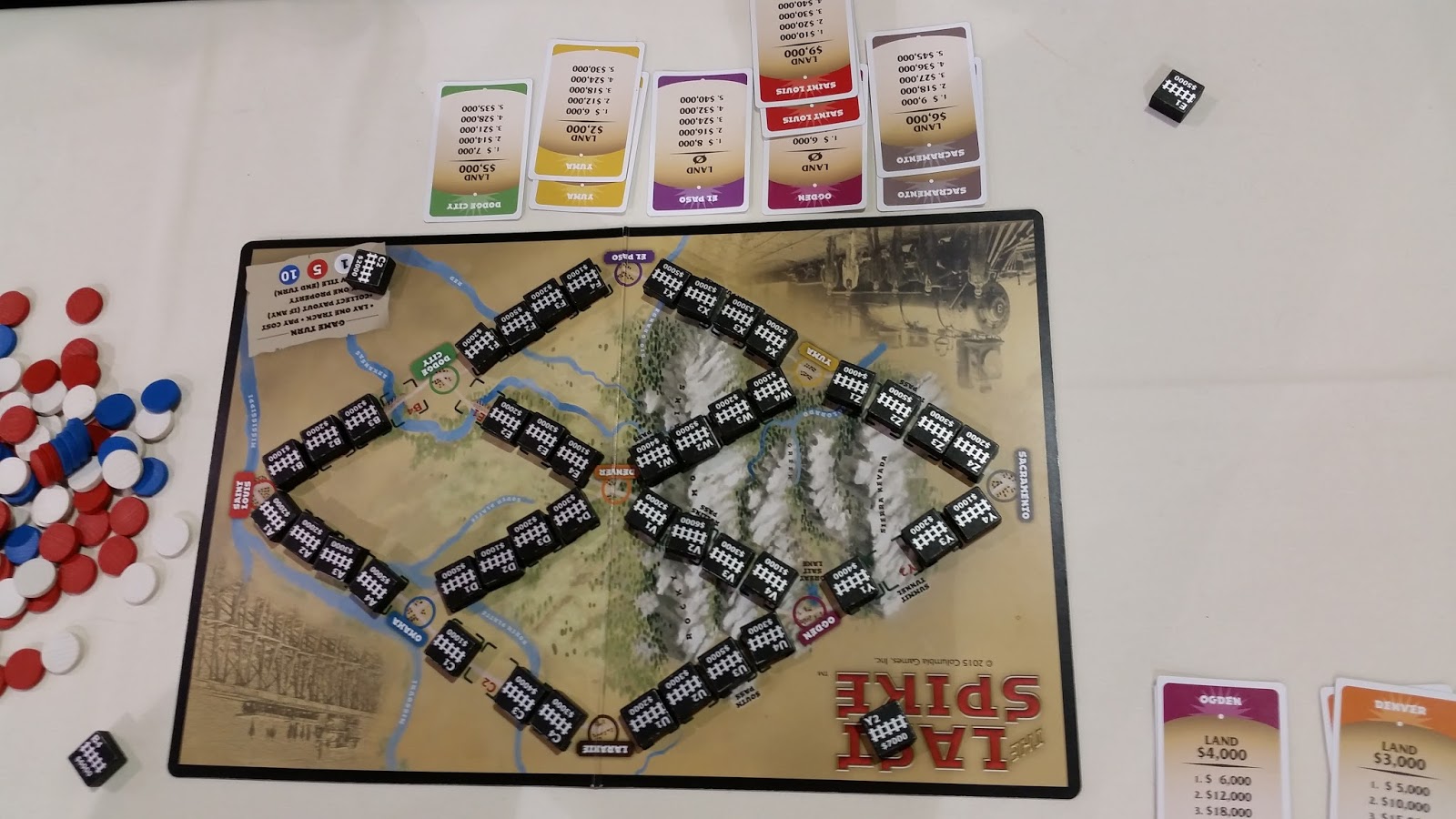 So the only question is, do you have the steel to take it to the end of the line?


